The brief
Shell Eco-Marathon is about going as far as possible on as little fuel as possible, and that starts with a chassis that's as light as the rules and physics allow without flexing where it shouldn't. As our final-year capstone (MECH 460), a team of five of us designed a new chassis for the Queen's Supermileage team to build and race.
What we did
- Ran the design process properly: QFD analysis and weighted evaluation matrices to compare chassis types (monocoque, ladder, backbone, space frame) against the rulebook, the budget, and what the team actually needed.
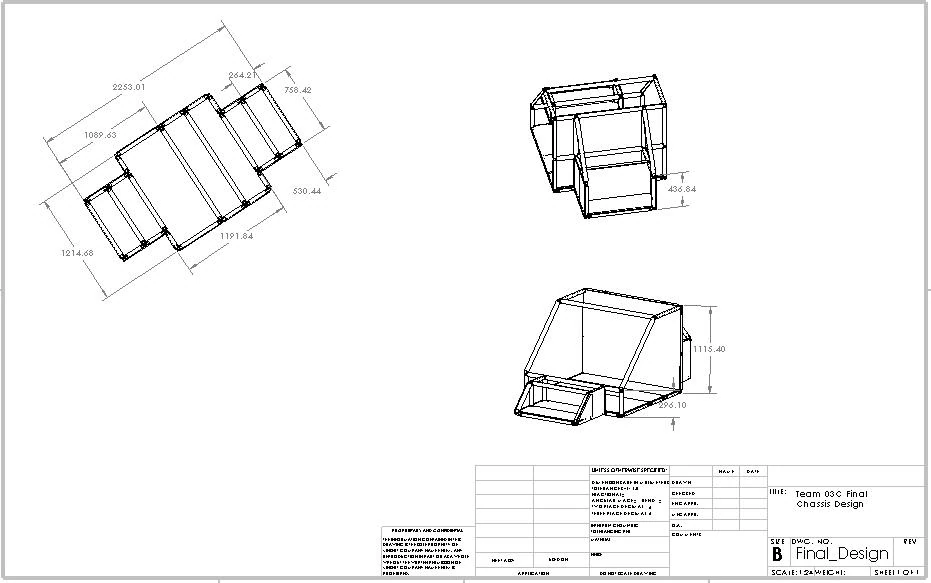
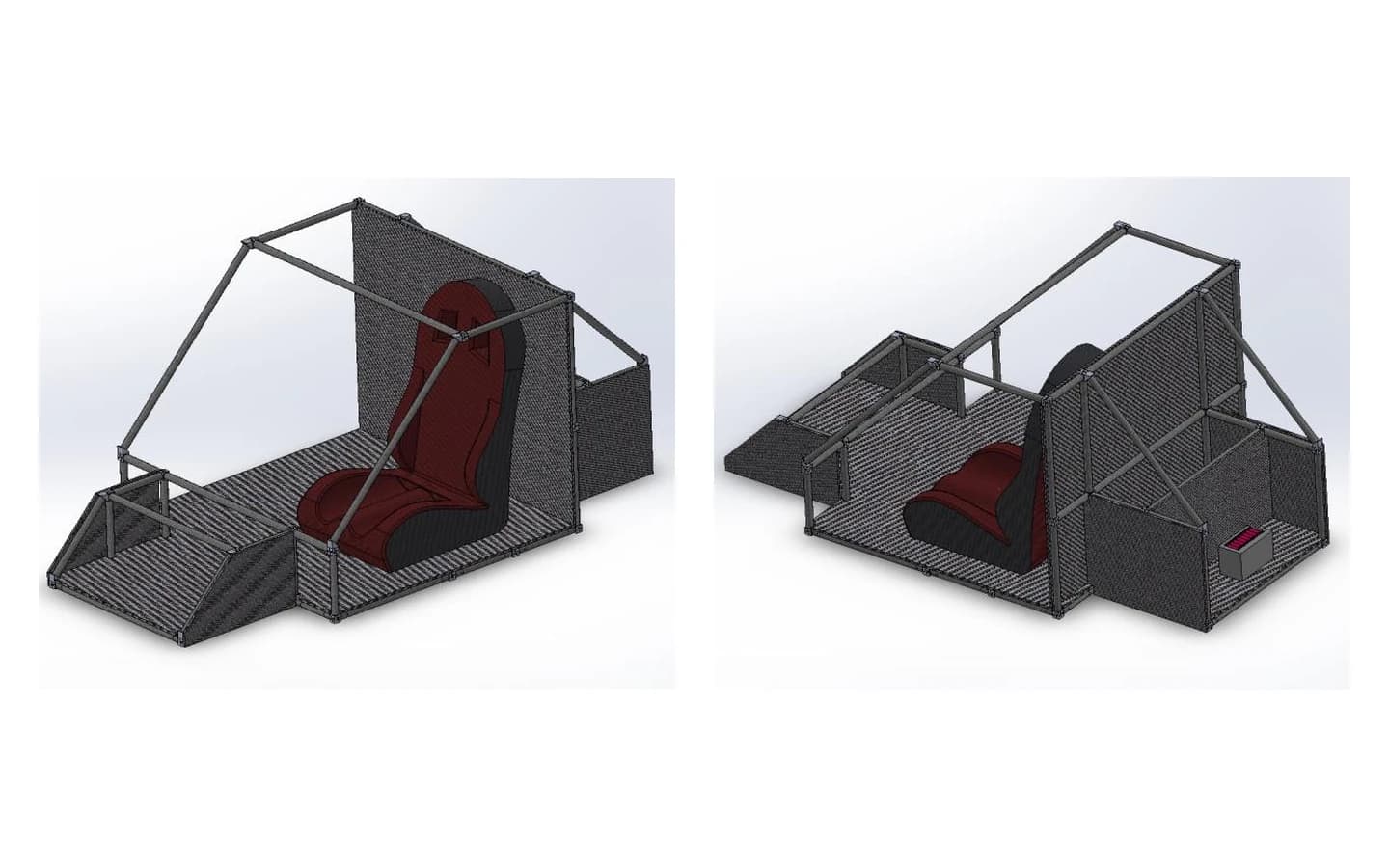
- Landed on a "skateboard" layout in carbon fibre: thin-walled carbon-fibre tubes joined with off-the-shelf 45° and 90° connectors, over a carbon-fibre sandwich-panel base that spreads the loads and keeps shear out of the brittle tubes.
- Modelled the full assembly in SolidWorks using real manufacturer part models, then analysed it in ANSYS with beam elements, cross-validating the two tools against each other on a simple cantilever case before trusting either.
- Checked the cases that matter: the rulebook's 700 N rollbar load in every direction with a 50 mm deflection limit around the driver's head, plus base loading.
- Came in at an estimated 93.78 kg against the rulebook's 140 kg limit, and roughly $3,100 in materials against a $10,000 budget, mostly by keeping every joint at 45° or 90° so nothing needed custom manufacture.
The interesting part
Lightweighting is a game of trade-offs. Every gram you take out has to come from somewhere that won't bite you later. The other lesson was computational: a full composite FEA model of thin-walled tubes is beautiful and useless, because it won't finish meshing. Simplifying to beam elements, then proving the simplification against a second tool, is what actually got us an answer we could stand behind.